
Buying an industrial operator seat through standard MRO catalogs rarely survives first audit. Procurement teams discover too late that IP ratings were declared on closed lids only, monitor mounts were treated as IT accessories, and “CE chair” documentation did not cover lateral PLC boxes added on site. This guide lists what procurement, EHS, and maintenance should include in RFQs for integrated control console awards — and how to evaluate vendors who engineer the complete station rather than ship furniture first and negotiate gaps later.
Review EOS and TIA as configuration baselines, or contact sales@trunsin.com for RFQ support. Cluster references: IP31 enclosure implementation, IEC 60204-1 alignment, and our operator seat upgrade case study.
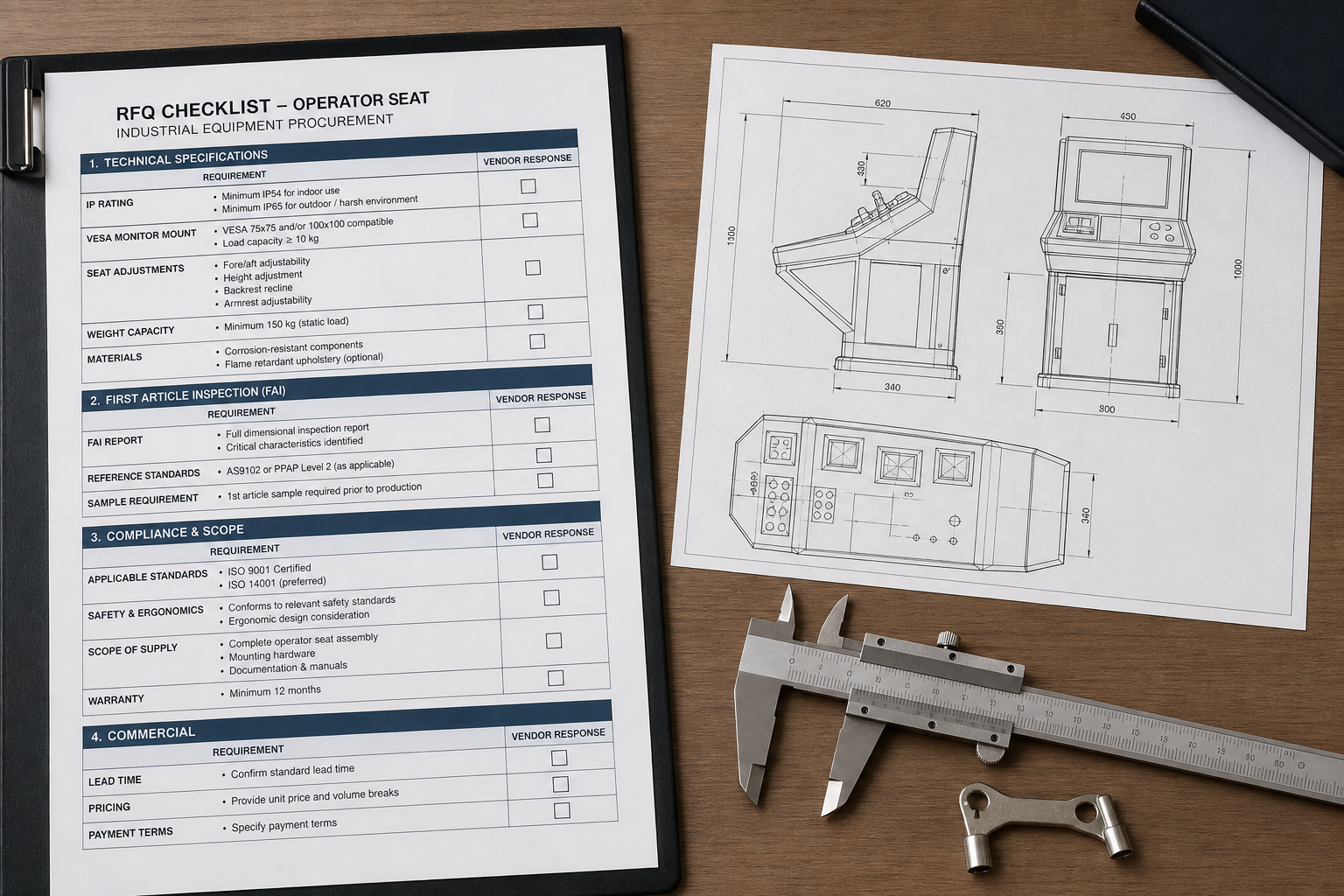
RFQ essentials: ten items integrators forget
- Application environment — Steel, mining, crane, shredder; dust, pickling, washdown proximity
- Reference drawings and photos — Existing station front, side, lids open
- Monitor specification — VESA pattern, mass, cable exit, orientation lock
- IP targets for both lid states — Closed (e.g. IP31) and opened (e.g. IP20) documented separately
- Compliance scope — IEC 60204-1 themes, CE on complete assembly, regional requirements
- Anthropometric targets — Two operator weight/height brackets minimum, including PPE
- Access hardware policy — Double-bit key, padlock hasp, or other tool-only requirement
- Materials by zone — 304 stainless vs RAL paint where corrosion risk differs
- First-article and gap-record acceptance — Numbered findings with re-inspection sign-off
- Batch gate criteria — Repeat PO release tied to signed gap-record revision
Missing any one item typically generates a change order after first article — the most expensive phase to reopen enclosure depth, gasket paths, or compliance documentation.
Vendor evaluation: integration outcomes, not chair SKUs
Favor suppliers who:
- Release revision-controlled 3D models before cutting metal
- Document video verification for functional motions — rotation lock, box opening, monitor clearance
- Close findings on numbered gap records with owner and re-inspection columns
- Scope compliance on the complete operator seat assembly, not the chair alone
- Provide first-article evidence before batch gate, not post-shipment negotiation
Avoid vendors whose quotation covers only a catalog chair while lateral boxes, monitor masts, and compliance documentation are “customer scope” — that split is where audits fail and maintenance inherits undocumented assemblies.
Commercial terms that protect uptime
Link repeat purchase order release to signed gap-record revision. Specify spare wear blocks for rotation locks, double-bit keys, and gasket kits for lateral boxes — consumables that differ from office-chair parts catalogs.
Define lead time assumptions explicitly: custom configuration requires first article; share target in-service dates at RFQ so scheduling includes 3D review, first-article inspection, corrective actions, and re-inspection — not just fabrication weeks.
How we validate before you sign the batch gate
Trunsin runs procurement-facing evidence through the same workflow mechanical and compliance teams see:
- Intake review — RFQ completeness check; missing IP states or monitor specs flagged before quotation
- Gap record at first article — Enclosure sealing, ergonomics, mechanical reliability, and compliance/access findings numbered with owners
- 3D design release gate — No production metal until revision-controlled model matches agreed scope
- Video verification — Functional evidence for remote EHS and maintenance stakeholders
- Re-inspection sign-off — Each gap-record row closed before batch authorization
- Batch gate — Customer-confirmed gap record = ship criteria for repeat deliveries
Procurement teams receive gap-record summaries suitable for internal audit — not informal email threads.
Procurement checklist for sign-off
| Review area | Question to ask the vendor | Acceptable evidence |
|---|---|---|
| Scope | Does quotation cover complete integrated station? | Drawing bill of materials incl. boxes and mast |
| IP | Are closed and opened states documented? | Dual-state declaration on gap record |
| Compliance | Is CE/IEC scope on full assembly? | Intake agreement + labeling on 3D release |
| Ergonomics | How many operator brackets validated? | Verification video with seated operators |
| Mechanical | Foot rest load criterion defined? | Static load test on gap record |
| Process | What triggers first-article repeat? | Written batch gate policy |
Frequently asked questions
Should operator seats be a separate PO from joysticks?
Integrated pulpits often combine both under one engineering program. Align PO structure with whoever owns system compliance and gap-record closure — splitting POs without splitting responsibility creates audit gaps when grounding labels span joystick panels and lateral boxes.
What lead time should we plan for custom operator seats?
Budget for intake review, 3D release, first-article inspection, corrective actions, and re-inspection — not fabrication time alone. Share target in-service dates at RFQ; rush orders that skip first article typically pay rework costs after installation.
How do we compare quotes with different IP or compliance language?
Normalize quotes against the ten RFQ essentials above. A lower price that excludes opened-lid IP state, monitor mass, or complete-assembly CE scope is not comparable — it deferrals scope to site integration.
Can we use our corporate MRO contract for operator seats?
Office furniture contracts rarely include lateral PLC enclosures, VESA industrial mounting, or IEC 60204-1 labeling on integrated assemblies. Route custom pulpits through capital or project procurement with engineering review — not generic seating catalogs.
What documentation should we receive at batch gate?
Signed gap-record revision, first-article evidence summary, released drawing index, and spare-parts list for rotation locks, keys, and gaskets. Request format at RFQ so documentation is not assembled ad hoc after shipment.
Start your operator seat project
- Download or adapt the ten RFQ essentials into your specification template
- Share application photos and reference drawings
- Contact sales@trunsin.com for quotation and gap-analysis path