
A leading European steel automation customer asked us to upgrade an industrial operator seat and integrated control console used on a shredder line — not a catalog swap, but a configuration project with a high degree of customization across chair geometry, lateral electrical enclosures, monitor mounting, materials, and safety compliance. The program ran from first article inspection through mid-2025, driven by a numbered punch list with 3D review, video verification, and formal re-inspection before any production batch shipped.
This article shows how rigorous process discipline and deep configurability closed more than a dozen technical gaps on the operator seat program — and what other OEMs can apply when upgrading cabin or pedestal controls. Browse Trunsin control console platforms such as EOS and TIA, or contact sales@trunsin.com for a custom operator seat project.
Why is every operator seat a configuration project
Industrial operator seats are rarely interchangeable with catalog office or vehicle furniture. Each plant assigns different monitors, PLC enclosures, lock policies, corrosion exposure, and operator anthropometrics. Trunsin treats the chair, lateral boxes, and monitor mast as one engineered assembly — dimensions, materials, and compliance path are chosen per application, not pulled from a fixed SKU matrix.
For this European steel-automation program, the customer supplied reference drawings and a structured punch list. Every gap — from VESA pattern to box depth to foot-rest load — became a tracked configuration decision with owner, corrective action, and re-inspection sign-off. That is the opposite of swapping a standard chair and bolting on generic side panels.
Customization matrix: what we tailor on an operator seat
| Configuration area | What we tailor | Example from this project |
|---|---|---|
| Seat geometry & ergonomics | Seat height, foot-holder position, hand rest on chair vs lateral box, reclining lever reach | Foot-holder lowered ~100 mm; validated against ~520 ± 20 mm European reference seat height |
| Operator body types | Reach, knee clearance, box opening clearance for representative height/weight | Verified with operators ~90 kg / 182 cm and ~70 kg via dimensioned 3D review and video |
| Lateral electrical boxes | Box depth, inter-box spacing, clearance from seat edge | Depth set to ~375 mm; inter-box distance widened to ~580 mm per customer reference drawings |
| IP rating & sealing | Gasket routing, edge passivation, IP31 closed / IP20 opened claims | Non-standard gasket paths corrected; sharp plate edges passivated |
| Materials & finish | 304 stainless steel vs painted steel, RAL colour, pickling vs corrosion exposure | 304 SS option offered where paint alone would not survive plant atmosphere |
| Monitor mast & VESA | VESA 100 × 100 and 200 × 200, horizontal-only lock, bracket stiffness, fastener length | Open-frame ~22″ touch (~5 kg); shortened deburred fasteners; reinforced bracket after arm shake |
| Rotation & lock | Bearing stack, anti-vibration base, rotation lock mechanism, adjustable wear block | Paired top/bottom bearings; lock redesign for reliable long-term engagement |
| Foot rest & structure | Stiffening plates, load rating, omega bar base detail | 140 kg load test without permanent deformation; omega bar re-engineered |
| Access & safety | Double-bit key on lids, gas spring routing (internal vs external), grounding bolt labels | Internal-side gas springs; earth labels on released 3D model; tool-only box access |
| Compliance path | IEC 60204-1 alignment, CE marking scope on complete assembly | CE-ready chair assembly; UL not required for this project |
If your specification touches even three rows in this table, you are not buying a catalog chair — you are running a configuration project. That is normal for shredder lines, crane cabins, and steel-plant control pulpits.
How we engineer a custom operator seat
Rigor is not a marketing word here; it is how we prevent rework on an operator seat that must survive decades of shifts. The workflow below is what closed the punch list on this program and is the same discipline we apply to custom control console and industrial joystick builds.
Engineering workflow
- Intake — Customer reference drawings, existing chair photos, monitor spec, corrosion and access rules.
- Punch list / gap record — Each finding logged with issue date, description, corrective action, owner, and re-inspection column. Nothing closes without evidence.
- 3D design review — VESA plates, lock geometry, gasket paths, box depth (~375 mm vs earlier 380/400 mm targets), grounding symbols checked before cutting metal.
- Design release — Revision-controlled 3D model is the contract between engineering and shop floor.
- Video verification — Short clips prove rotation lock engagement, monitor movement without snagging, foot-rest load, box opening clearance with a seated operator — not CAD manikins alone.
- Re-inspection — Rev01 checklist; conditional closes carry explicit re-test notes before the next delivery batch.
- Compliance release — IEC 60204-1 labeling, CE marking scope, double-bit key policy, and access rules documented on the released assembly.
- Batch gate — Customer-confirmed punch list becomes the gate for subsequent shipments.
The punch list is the proof of rigor: more than a dozen tracked items, each with traceability from first article failure through accepted or conditionally closed status. That audit trail is what separates a one-off prototype from a repeatable operator seat platform your maintenance team can trust.
Why punch-list driven operator seat upgrades matter
Industrial control furniture sits at the intersection of ergonomics, electrical safety, and decades-long duty cycles. A sample that looks acceptable in a showroom often fails in the field: operators collide with monitors, lateral boxes sit too close to the seat, rotation locks slip, or sealing does not meet the declared IP rating.
For this program we used a numbered punch list — issue date, description, corrective action, owner, and re-inspection notes — so every finding had traceability. That mirrors how we now handle joystick specifications through our online configurator: define requirements, validate, document, ship.
Starting point: what failed first inspection
Initial review highlighted gaps in four areas:
| Area | Example findings | Risk if ignored |
|---|---|---|
| Enclosure finish & sealing | Sharp plate edges, scratched surfaces, non-standard gasket routing | Operator injury, corrosion, failed IP claims |
| Ergonomics | Boxes too close to seat, knees hitting monitor, uncomfortable leg height | Fatigue, misuse, reduced productivity |
| Mechanical reliability | Rotation lock unstable, foot rest flex under load, monitor arm shake | Unsafe adjustments, repeat service calls |
| Compliance & access | Missing grounding labelsa ,, safety belt still fitted, boxes open without tool | Audit failures, unintended access |
Ergonomics: spacing, legs, and real operators
Steel plants run shifts with different body sizes. We validated changes with operators around 90 kg and 182 cm / 70 kg rather than theoretical CAD manikins alone.
- Lateral box clearance — Enclosures were moved outward so boxes could open fully and the reclining lever remained reachable without trapping the operator.
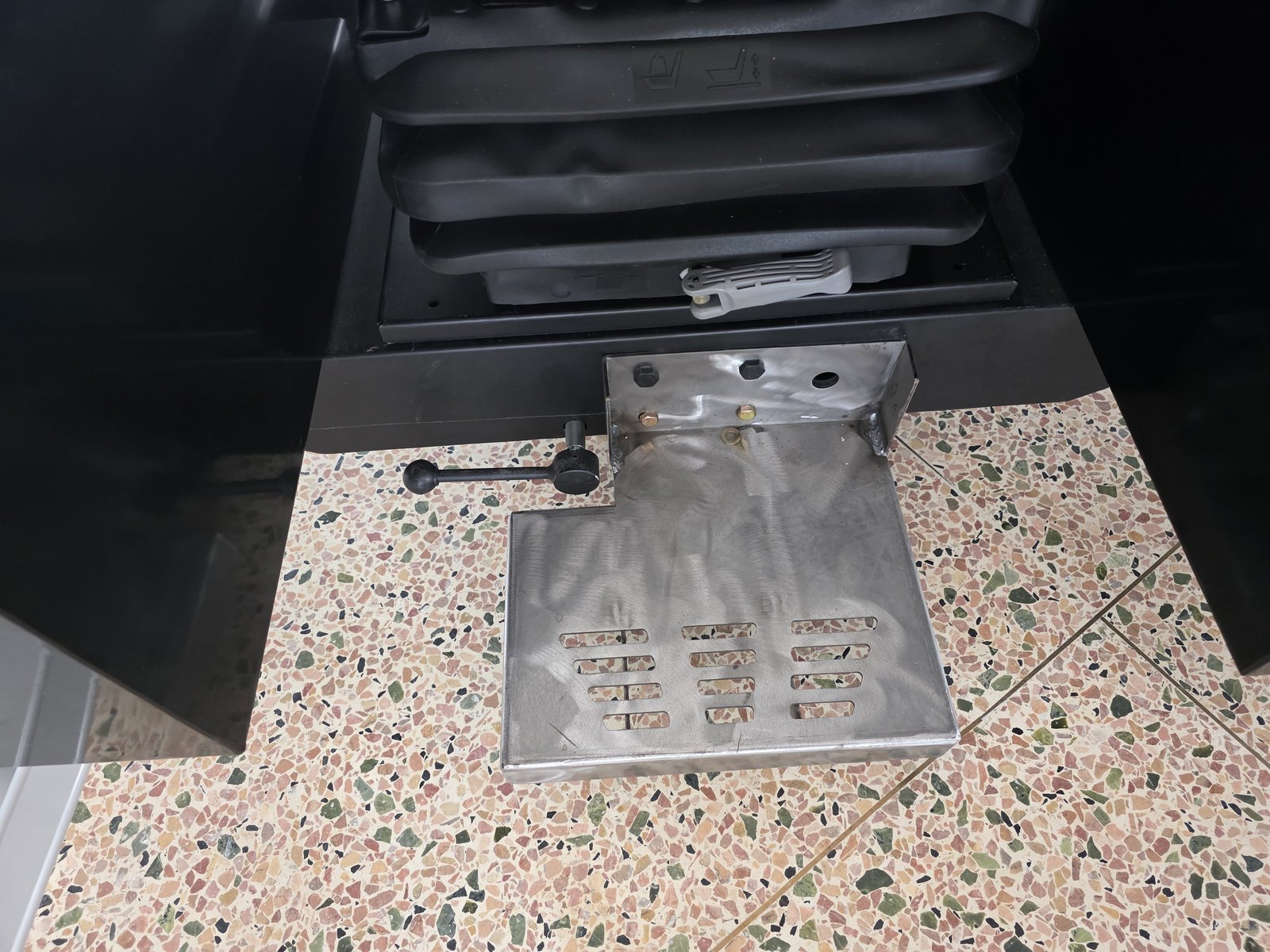
- Leg comfort — Foot-holder position was lowered (~100 mm) after video review; European reference seats typically sit near 520 ± 20 mm seat height — we reconciled our geometry against that benchmark.
- Knee vs monitor — Monitor bracket and seat geometry were adjusted so tall operators no longer struck the screen when seated.
- Inter-box distance — After studying the customer’s reference drawings, distance between lateral boxes was widened to ~580 mm to give operators more lateral space.
- Hand rest placement — Evaluated on chair vs lateral box depending on reach and box lid swing.
Structure: load, vibration, and rotation
- Foot rest reinforcement — Stiffening plates were added; validation included a 140 kg load test without permanent deformation.
- Anti-vibration rotation base — Single-bearing stack was replaced with paired top/bottom bearings and controlled clearance to reduce wobble on the plant floor.
- Rotation lock redesign — Lock mechanism was simplified so engagement stays reliable over time, with an adjustable wear block for long-term tension.
- Omega bar base — Missing structural base detail was re-engineered to match the proven middle-structure approach.
Monitor mounting: VESA, lock, and reinforcement
The customer standardizes on open-frame touch monitors (typical 22″ class, ~5 kg). Requirements included:
- VESA 100 × 100 and 200 × 200 patterns on the stand plate
- Shortened, deburred fasteners so the stand rotates without snagging and edges cannot cut operators
- Horizontal-only monitor orientation with a positive lock — tilt/height adjustment via a reinforced bracket after early arm shake was traced to loose fasteners
Electrical enclosures: IP, materials, and access
Lateral boxes had to meet practical plant rules, not just datasheet numbers:
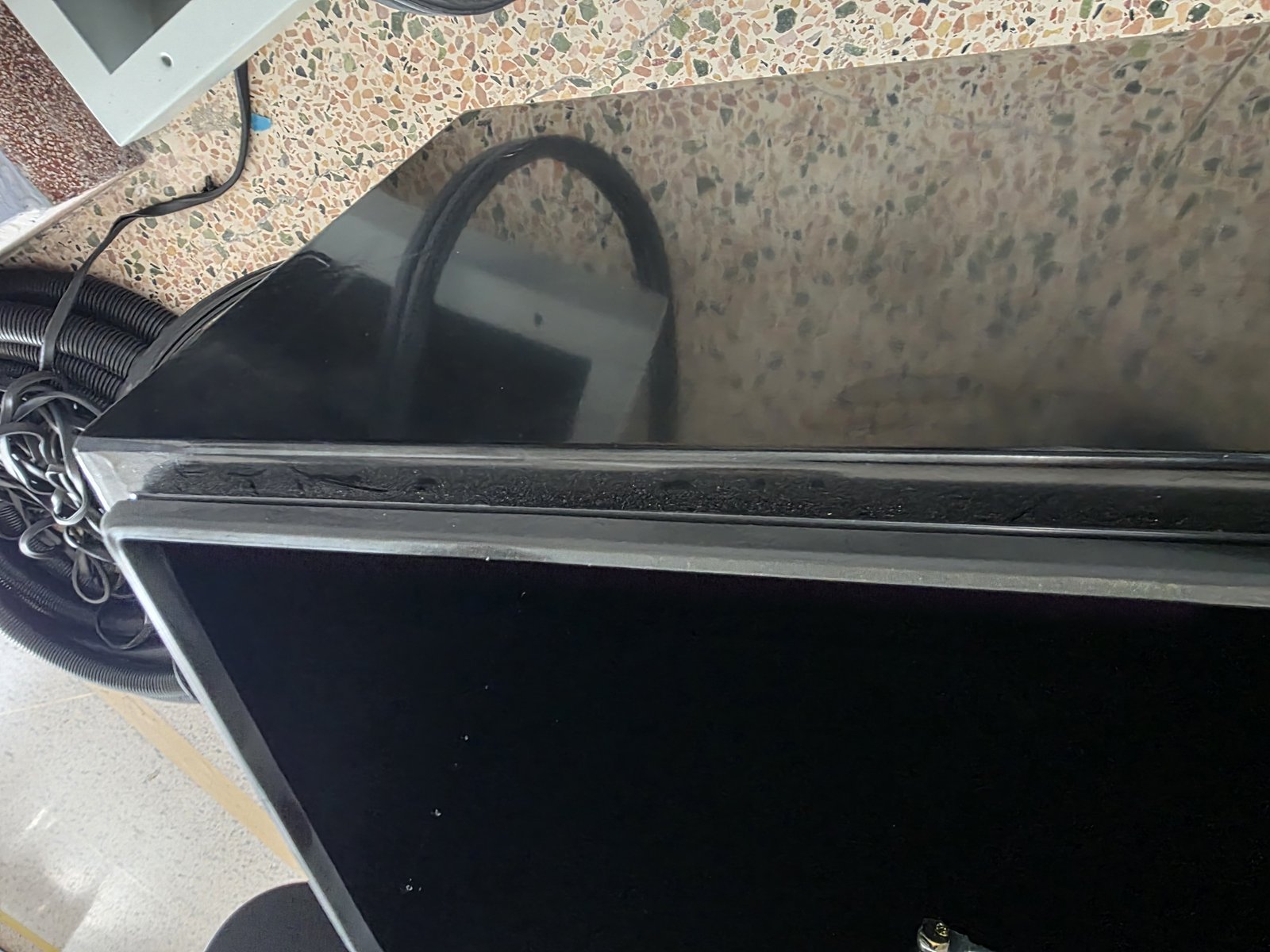
- IP31 closed / IP20 opened with improved gasket design and passivation on sharp edges
- IEC 60204-1 alignment and CE marking on the complete chair assembly (UL not required for this project)
- 304 stainless steel option for corrosion resistance instead of relying on paint alone
- Double-bit key on box lids so only maintenance staff with the tool can open live enclosures
- Grounding bolts marked with earth labels on the released 3D model
- Gas springs routed on the internal side of lids as specified
Gas-spring placement, sealing routes, and grounding symbols were checked against 3D releases before metal was cut — the same revision discipline we use on industrial joystick custom builds.
Process: how we closed the list
The eight-step workflow above condensed into what the shop floor executed on each punch-list cycle:
- Record — Each finding logged with date, photo/video reference, and owner.
- Design — 3D model updates (VESA plate, lock, seals, box depth ~375 mm vs earlier 380/400 mm targets).
- Prove — Short verification videos: rotation lock, monitor movement, overweight foot-rest test, box opening clearance.
- Re-inspect — Rev01 checklist sign-off before next delivery batch.
Videos and re-inspection notes are not optional extras — they are how we prove an operator seat configuration works for real operators before CE documentation and batch release.
Results
By revision 01 of the punch list, critical ergonomics and sealing items were accepted or conditionally closed with explicit re-test notes. Remaining cosmetic paint checks were tied to material choice (pickling vs 304 stainless). The customer confirmed the checklist as a gate for subsequent shipments.
For Trunsin, the program reinforced a pattern we see across products: field feedback on control consoles and joysticks converges on the same themes — reachable adjustments, honest IP implementation, labeled grounds, and documentation the next shift can trust.
Frequently asked questions
Can Trunsin customize control consoles beyond standard EOS or TIA models?
Yes — every operator seat is a configuration project. Operator chairs, lateral boxes, monitor masts, VESA patterns, materials, lock types, and compliance packages are engineered to your punch list or reference drawings, not selected from a fixed catalog. See control console products or email sales@trunsin.com.
Do you support CE and IEC 60204-1 for complete operator stations?
We align enclothe ,the ,was The missinga ,the that and the the shakessure and labeling design to customer requirements including IEC 60204-1 and CE marking scope. Lead time for formal CE documentation depends on configuration and notified-body paths — plan early in the project timeline.
How do you validate ergonomics remotely?
We use dimensioned 3D reviews plus short operator videos (body-height/weight representative) for reach, knee clearance, box opening, and foot-rest comfort — the same evidence style used to close this steel-automation upgrade.
What should we send to start a custom operator seat project?
Reference drawings (even hand-marked), monitor VESA spec, IP and material requirements, operator anthropometric targets, and any existing punch list. We return a gap analysis and 3D review path before metal is cut.
Related articles
- Online industrial joystick configurator — 3-minute spec workflow
- Industrial joystick safety in mining
- CANbus joystick for construction equipment
Start your operator seat project
- Share application drawings or an existing punch list
- Review standard control console platforms as starting points — not finished products
- Contact sales@trunsin.com for engineering review and quotation