
Open-frame touch monitors on an operator seat impose static and dynamic loads catalog monitor arms rarely see: vibration-induced arm shake, rotation envelopes that snag on lateral boxes, and tall operators striking the lower bezel when knee clearance was never checked against screen position. Trunsin engineers VESA mounting as part of the complete control console assembly — bracket stiffness, deburred fastener length, horizontal lock options, and combined 3D review with seat geometry and box depth.
Confirm monitor specs at intake alongside EOS and TIA platform baselines, or contact sales@trunsin.com for engineering review. Related reading: shredder-line operator seat design and foot rest load validation.
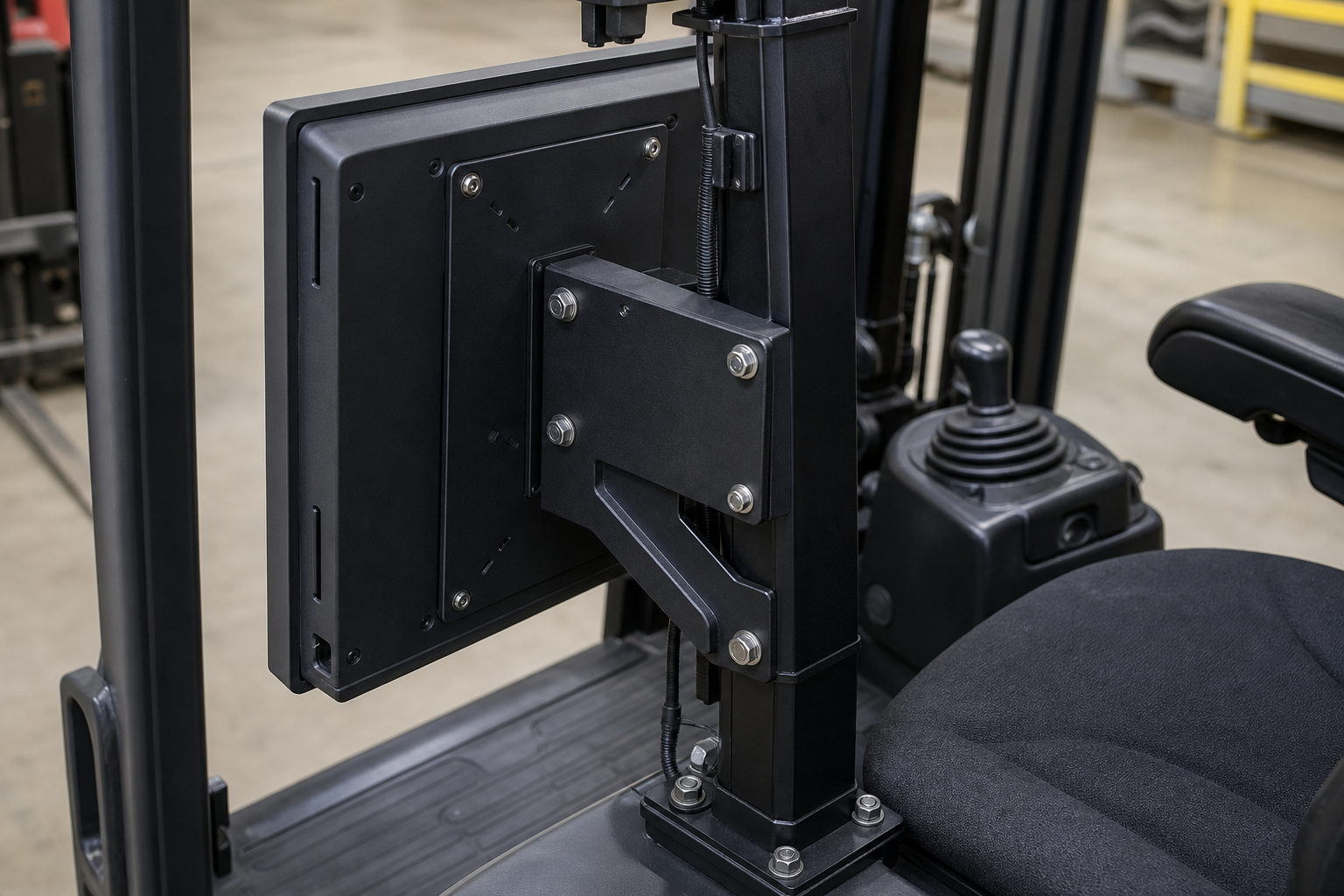
VESA 100 × 100 and 200 × 200 on one stand plate
Industrial customers often standardize on roughly 22-inch open-frame touch panels near 5 kg mass. Trunsin provisions both VESA 100 × 100 and 200 × 200 patterns on a common stand plate so one operator seat platform accepts multiple monitor generations without mast replacement — a procurement decision that reduces spare-part complexity across plant upgrades.
At quotation, confirm:
- VESA pattern and hole spacing
- Monitor mass including any front glass or bezel
- Cable exit direction and service loop length
- Touch controller box location relative to lateral enclosures
Fastener length, rotation envelope, and snagging
Office monitor arms use fastener lengths suited to thin bezels. On integrated pulpits, protruding screws catch on lateral box lids, reclining levers, and rotation paths. Trunsin shortens and deburrs fasteners so the monitor clears the full rotation envelope — a detail that only appears when bracket geometry is reviewed against the complete seat assembly in 3D, not when a monitor is bolted on after delivery.
Horizontal lock and reinforced brackets under vibration
Some applications require horizontal orientation with a positive lock to prevent gradual drift during vibration duty — crane pulpits, shredder lines, and mining cabins share this requirement. When first-article testing reveals monitor arm shake, root cause analysis typically points to fastener torque, bracket stiffness, or inadequate stand-plate thickness — resolved with a reinforced bracket and documented torque spec, not operator tightening alone.
Monitor duty connects to rotation lock and anti-vibration base decisions on the same gap record. Changing bearing stack or lock geometry without re-checking monitor arm stiffness invites drift or shake after months of production shifts.
Knee clearance vs screen position
Tall operators striking the lower bezel is an ergonomics failure that appears late when monitor mounting is treated separately from seat geometry. Trunsin runs combined 3D review: bracket height, seat pan angle, lateral box depth, and foot-holder position adjusted together. The limiting factor is often lid swing and knee clearance against an open-frame display — not lumbar knobs on a catalog chair.
How we validate monitor mounting
- Intake spec — VESA pattern, mass, cable exit, and orientation lock requirement captured before 3D release
- 3D gate — Rotation envelope, fastener protrusion, and knee clearance checked against two operator anthropometric brackets minimum
- First article — Arm shake test under representative vibration; fastener torque recorded
- Video verification — Monitor movement through full rotation without snagging; seated operator knee clearance confirmed
- Gap-record closure — Reinforced bracket or geometry change re-inspected before batch gate
VESA monitor specification checklist
| RFQ item | What to specify | Validation approach |
|---|---|---|
| VESA pattern | 100 × 100 and/or 200 × 200 | Stand plate provision on released drawing |
| Monitor mass | Panel + bezel + touch controller | Bracket stiffness sized in 3D gate |
| Orientation | Horizontal lock required Y/N | First article + video verification |
| Cable exit | Direction and service loop | Rotation envelope check in 3D |
| Knee clearance | Tallest operator bracket + PPE | Combined ergonomics video |
| Vibration duty | Application environment | Arm shake test at first article |
Frequently asked questions
Which VESA patterns does Trunsin support on operator seats?
Typically VESA 100 × 100 and 200 × 200 on a common stand plate. Confirm monitor mass and cable exit direction at quotation — non-standard patterns require engineering review before design release.
Can the monitor mast rotate with the operator seat?
Rotation behavior depends on bearing stack, lock mechanism, cable service loop, and lateral box clearance. Trunsin engineers per application with video verification; repurposed office monitor arms rarely survive industrial rotation duty without snagging or shake.
Should we specify the monitor in the operator seat RFQ or separately?
Include monitor VESA pattern, mass, cable exit, and orientation lock in the integrated pulpit RFQ. Treating displays as IT accessories late in procurement forces bracket and knee-clearance rework when the open-frame panel arrives on site.
What causes monitor arm shake after months of operation?
Loosening fasteners under vibration, insufficient bracket stiffness for panel mass, or stand-plate flex. First-article shake testing and documented torque specs catch these before batch release; field shake usually traces to one of these root causes.
How does VESA mounting interact with IP sealing on lateral boxes?
Monitor mast position affects operator reach, box lid swing, and cable routing into sealed enclosures. Combined 3D release prevents late conflicts between screen position and gasket paths on adjacent lateral boxes.
Start your operator seat project
- Send monitor datasheet: VESA pattern, mass, cable exit, touch controller location
- Define orientation lock and vibration environment
- Contact sales@trunsin.com for integrated mounting review