
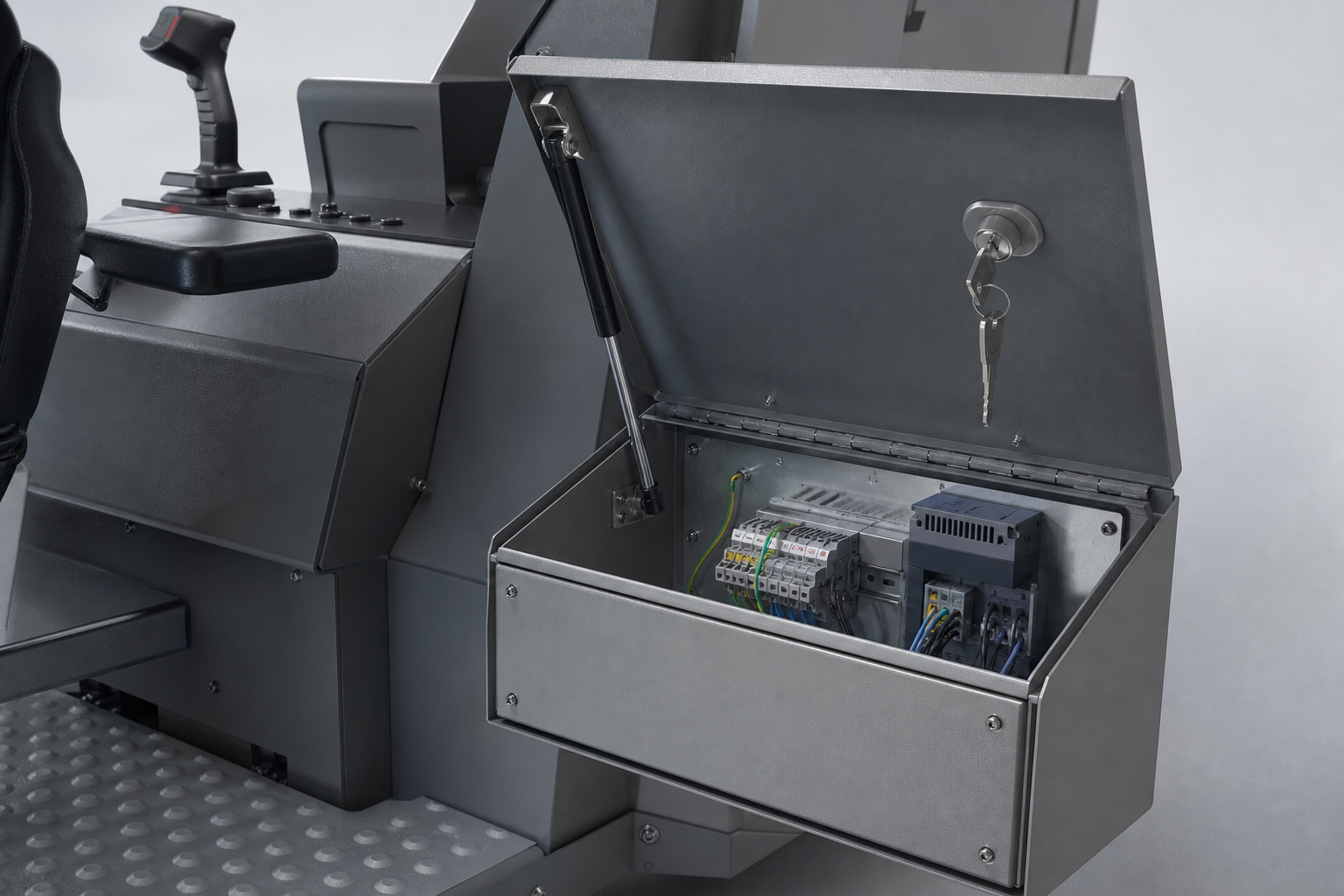
IEC 60204-1 does not stop at the motor starter cabinet. When an operator seat carries lateral PLC boxes, monitor power, grounded metalwork, and lockable lids, electrical safety expectations apply to the complete station — chair, enclosures, access policy, and documentation together. Trunsin aligns CE marking and IEC 60204-1 themes on full control console assemblies: grounding symbols on released 3D models, double-bit key access, internal gas-spring routing, and compliance findings tracked on the same structured gap record as ergonomics and sealing. Early alignment prevents rework when auditors ask how an operator opens a box without defeating safety intent.
Browse control console platforms such as EOS and TIA as engineering baselines, or contact sales@trunsin.com for compliance scoping. See also our operator seat upgrade case study for assembly-level compliance in practice.
Assembly-level compliance, not chair-only CE
A common procurement mistake splits responsibility: the operator seat supplier ships a “CE chair” while the integrator owns electrical code on lateral boxes added later. On integrated control console builds, Trunsin scopes compliance at assembly level — what maintenance receives on site matches what appears on released drawings and gap-record closure records.
On integrated operator seat programs, Trunsin typically confirms:
- CE marking applied to the complete operator seat and integrated enclosure assembly when required by target market
- Grounding bolt labels placed on the revision-controlled 3D model and verified physically during re-inspection
- Double-bit key lids enforced tool-only access to energized compartments
- Gas springs mounted internally on box lids to reduce pinch exposure and keep hardware away from operator knees
- Mechanical items reviewed against safety intent — belt removal, armrest geometry, and access paths evaluated when they intersect electrical safety culture on control furniture
Compliance findings are not deferred to a “documentation phase.” Missing grounding labels and unintended box access fail first article inspection the same way a gasket leak would — logged with issue date, corrective action, owner, and re-inspection sign-off.
Grounding, labeling, and what maintenance actually sees
Maintenance teams troubleshoot grounds under time pressure between shifts. Earth labels must appear on the assembly they touch — not only on a PDF in a shared drive. Trunsin releases 3D models with grounding symbols on earth bolts; gap-record re-inspection confirms physical labels match the model before batch gate.
This discipline parallels how Trunsin handles specification exports on the online industrial joystick configurator: define requirements, validate against released documentation, document evidence, ship.
IEC 60204-1 themes mapped to operator seat design
| IEC 60204-1 theme | Operator seat implementation | Validation approach |
|---|---|---|
| Clear identification | Earth labels on grounding bolts in 3D release | Re-inspection vs physical assembly |
| Controlled access | Double-bit key on lateral box lids | First article — boxes must not open without tool |
| Protection during operation | Internal gas springs; lid swing clearance | Video: box opening with seated operator |
| Documentation scope | CE on complete assembly when required | Agreed at intake; market-specific scope |
| Integration with HMI | Open-frame touch monitor power routing | Enclosure heat and cable paths checked in 3D gate |
Pair electrical scope with HMI selection early. Analog potentiometer panels and digital touch HMIs impose different enclosure heat and cable routing constraints on the same operator seat frame — a decision that should appear on the gap record before metal is cut.
Planning compliance on the gap record, not after first article
Trunsin runs compliance items through the same workflow as mechanical and ergonomic findings:
- Intake — Target markets, audit requirements, access policy
- Gap record — Each finding with owner and re-inspection column
- 3D design release — Grounding symbols, gas spring routing, key type checked before cutting metal
- Video verification — Functional evidence for access and operator clearance
- Re-inspection — Checklist closure before next delivery batch
- Compliance release — IEC 60204-1 labeling and CE scope documented on released assembly
- Batch gate — Customer-confirmed gap record = ship criteria
When a grounding label or access policy fails first article, it is tracked like enclosure sealing — not reopened as a surprise during customer audit.
Frequently asked questions
Does Trunsin provide formal CE documentation for operator seats?
We align design to customer CE and IEC 60204-1 requirements on the scoped assembly. Documentation lead time depends on configuration complexity — engage engineering at intake, not after first article. CE scope on the complete station should be confirmed before design release.
Are UL-listed operator seats available?
Scope is project-specific. Share target markets and audit requirements; Trunsin maps compliance paths per assembly. UL and CE requirements are scoped separately at intake.
How are grounding points communicated to maintenance crews?
Released 3D models and assembly drawings carry earth labels on grounding bolts. Gap-record closure verifies physical labels match the model — the same evidence standard applied to IP31 gasket routing on lateral boxes.
Can IEC 60204-1 alignment be added after the chair is built?
Retrofitting labels and access policy onto a shipped assembly is expensive and auditable. Specify tool-only access, grounding label requirements, and CE scope in the RFQ. Late changes to box depth or lid routing ripple into grounding paths, gas spring placement, and documentation scope.
How does compliance interact with shredder-line or crane-pulpit applications?
The same assembly-level principles apply across applications. Shredder pulpits add particulate exposure and aggressive maintenance cadence; crane pulpits add vibration duty. Electrical safety scope — grounding, access, documentation — stays on the complete operator seat station regardless of application.
Start your operator seat project
- Share target markets, audit requirements, and any existing specification sheet
- Review control console platforms as baselines
- Contact sales@trunsin.com for compliance scoping and engineering review