
IP ratings on an operator seat lateral box are only as credible as gasket routing, lid closure geometry, and edge finish — not the number printed on a showroom datasheet. Trunsin declares IP31 closed / IP20 opened on integrated lateral enclosures: closed protects against vertically dripping water near washdown zones and condensing mill ceilings; opened acknowledges maintenance with lids raised and fingers or tools inside the compartment. This article explains what that dual-state declaration means in procurement specs and how Trunsin validates sealing before batch release.
Browse control console platforms such as EOS and TIA as engineering baselines, or contact sales@trunsin.com for enclosure review. For assembly-level context, see our posts on IEC 60204-1 alignment and shredder-line operator seat design.
Why catalog IP claims fail on control furniture
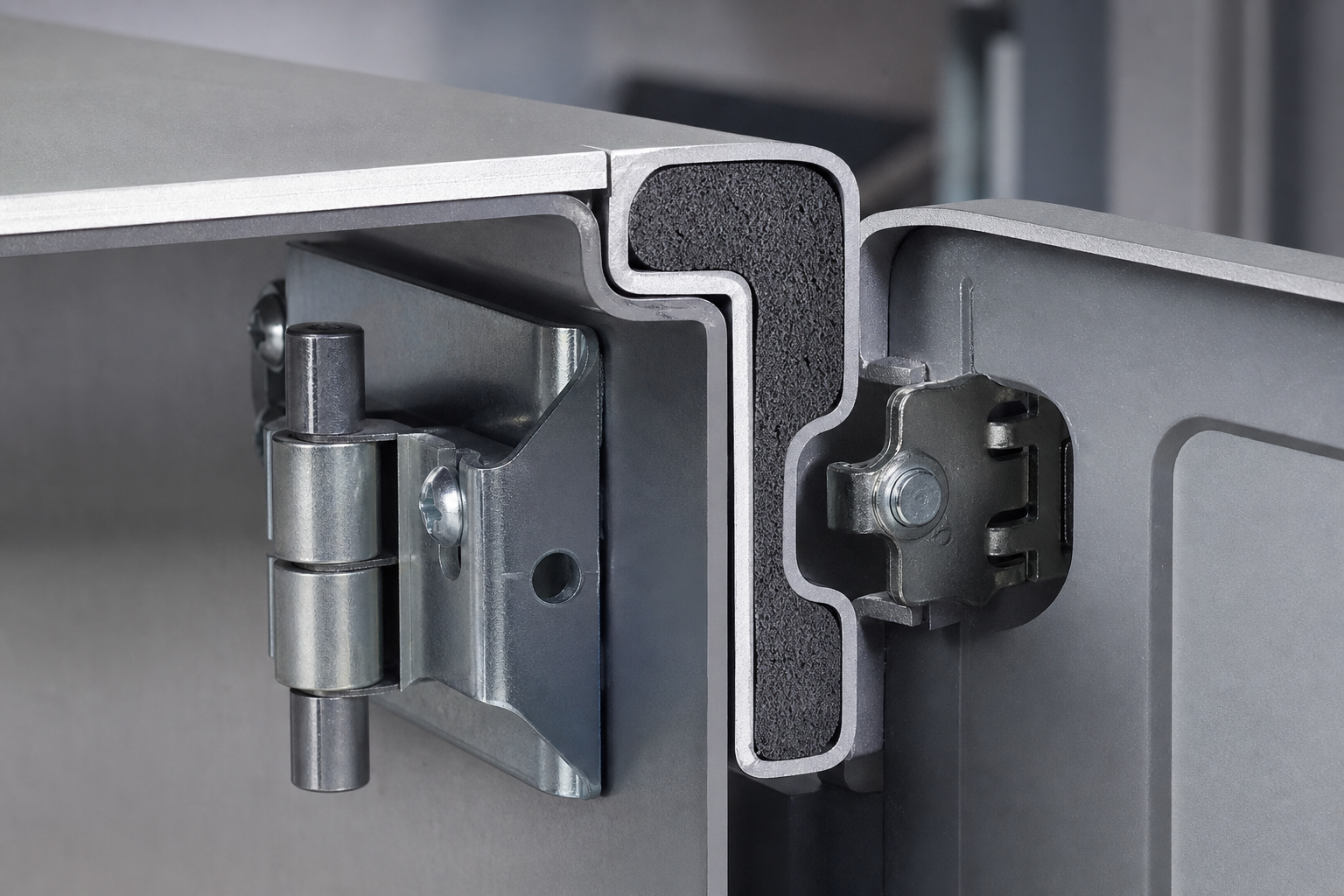
Sharp punched edges cut gasket foam over months of lid cycling. Scratched plate surfaces wick moisture in pickling atmospheres. Gaskets routed through non-standard compression paths pass a bench test once, then leak after the first hundred maintenance cycles when operators open lateral boxes weekly.
Office furniture suppliers rarely engineer gasket paths as part of the operator seat assembly. Trunsin treats lateral boxes as sealed enclosures integrated with chair geometry, monitor mast clearance, and gas-spring lid routing — not bolt-on accessories rated in isolation.
IP31 closed vs IP20 opened: write both states in the RFQ
Maintenance crews open lateral boxes during running shifts. A specification that cites only “IP31” without defining lid state invites over-claiming: the closed box may meet IP31 while the opened compartment realistically meets IP20. Trunsin documents both states on released drawings and gap-record closure.
- IP31 closed — vertically dripping water; relevant near condensing ceilings and occasional washdown proximity
- IP20 opened — maintenance access with lid raised; finger and tool clearance without pretending open equals closed protection
- Gasket continuity — path checked at corners, hinges, and latch points where compression is uneven
- Edge finish — passivation on punched plate edges that contact gasket foam
Materials that affect sealing longevity
Paint alone may not survive aggressive plant atmospheres. Where corrosion risk is high, Trunsin offers 304 stainless steel lateral panels alongside RAL paint finishes — a configuration choice tied to gasket seat longevity, not cosmetics alone. Stainless and painted paths use different edge-finishing steps; both appear on the gap record before first-article sign-off.
Sealing interacts with other enclosure decisions on the same operator seat program: double-bit key access, internal gas-spring routing, and grounding labels under IEC 60204-1 themes on the complete control console assembly.
How we validate IP implementation
Trunsin does not rely on supplier datasheets alone. Sealing findings close on the same structured gap record as ergonomics and mechanical reliability:
- Released drawings — Gasket routing, latch geometry, and edge finish notes on revision-controlled 3D models before metal is cut
- First article inspection — Physical review of sharp edges, gasket compression, and lid swing clearance with seated operator context
- Corrective actions — Passivation, gasket path correction, or latch adjustment logged with owner and re-inspection column
- Dual-state documentation — Closed and opened ratings recorded separately on acceptance records
- Batch gate — Re-inspection sign-off before repeat shipments; significant geometry changes trigger new first article
Video verification complements dimensional checks: box opening with a seated operator confirms lid swing does not tear gasket paths or expose unsealed edges during routine maintenance.
IP sealing specification checklist
| RFQ item | What to specify | Evidence Trunsin provides |
|---|---|---|
| Closed state | Target rating (e.g. IP31) and test reference | Drawing notes + first-article photos |
| Opened state | Realistic rating during maintenance (e.g. IP20) | Dual-state declaration on gap record |
| Edge finish | Passivation requirement on punched edges | Re-inspection vs physical assembly |
| Gasket path | Continuous compression at hinges and latches | 3D release + first-article review |
| Material zone | Paint vs 304 SS by atmosphere | Configuration documented at intake |
| Lid cycle duty | Expected opens per week | Gasket spec matched to maintenance cadence |
Frequently asked questions
Can IP rating be upgraded beyond IP31 on operator seat boxes?
Configuration-dependent. Higher targets require different gasket profiles, latch geometry, and sometimes cable gland strategies. Share washdown proximity, chemical exposure, and lid cycle frequency at RFQ; Trunsin maps feasible paths per application rather than promising a universal upgrade.
How do you prove IP implementation to remote procurement teams?
First-article photos, gasket routing on released drawings, gap-record re-inspection sign-off, and short verification video of lid opening with a seated operator. Evidence is tied to row numbers on the gap record for audit retrieval — not marketing gallery images.
Does opened-lid IP20 mean the box is unsafe during maintenance?
IP20 describes ingress protection with the lid open — not electrical safety policy. Tool-only access via double-bit key, internal gas springs, and IEC 60204-1 grounding labels address energized-compartment safety separately from ingress ratings.
Why do some vendors pass IP tests but fail in the field?
Bench tests on a single sample with ideal gasket compression do not reproduce weekly lid cycles, vibration-induced latch shift, or sharp edges that cut foam over time. Trunsin validates routing and edge finish at first article and tracks corrective actions before batch release.
How does IP sealing interact with monitor and ergonomics changes?
Box depth, inter-box spacing, and lid swing affect gasket path geometry. Late changes to monitor mast or foot-holder height ripple into lid clearance and seal compression — another reason to lock enclosure dimensions in 3D release before cutting metal.
Start your operator seat project
- Define closed and opened IP targets separately in your RFQ
- Share environment notes: dust, pickling, washdown proximity, lid cycle frequency
- Contact sales@trunsin.com for enclosure review and quotation