
During alarm response on a shredder line, operators do not sit politely — they brace against the foot rest, shift weight forward, and hold position while the line state changes. Catalog furniture ratings assume office loads; industrial operator seat foot rests need stiffening plates, integrated base structure, and a documented load test before any production batch ships. Trunsin validates foot rest structure during first article inspection: stiffening plates where flex is detected, omega bar base details re-engineered when load paths change, and static load proof recorded on the gap record and verified on video before batch gate.
Contact sales@trunsin.com for custom control console engineering, or browse platform baselines such as EOS and TIA. For the full upgrade workflow including foot-rest validation, see our operator seat upgrade case study.
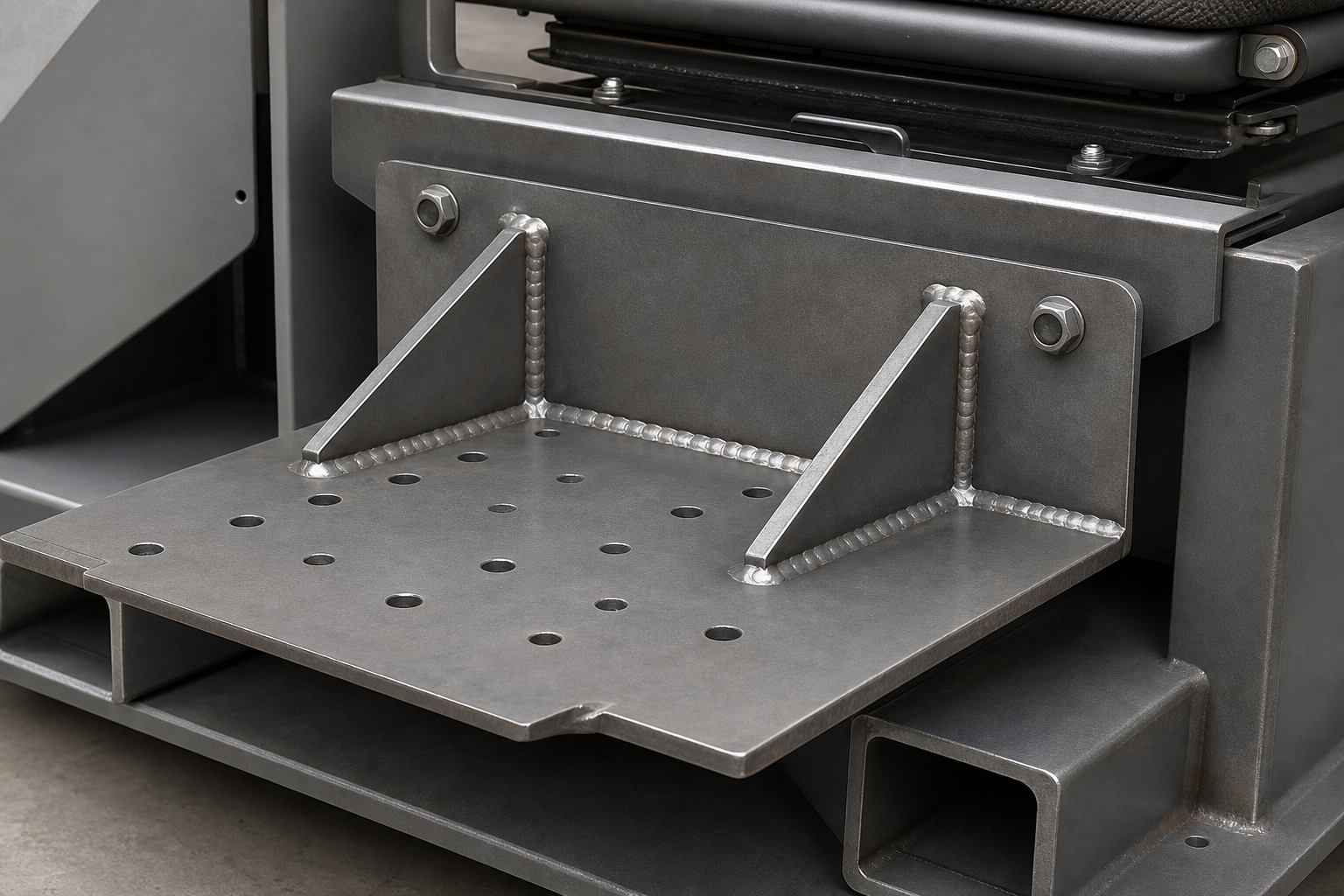
What first article inspection typically finds
Mechanical reliability sits alongside ergonomics and sealing on the first article gap record. Common foot-rest findings:
- Flex under operator load — unacceptable deflection during bracing, not gradual wear
- Load path changed after ergonomics fix — foot-holder height adjusted to improve leg comfort; the comfort fix redirects force into base structure
- Omega bar base — middle-structure detail re-engineered to match proven load paths after geometry changes
The foot rest is not treated as a cosmetic add-on. It is a structural member tied to batch release — same rigor as rotation lock redesign and monitor arm reinforcement on the same operator seat program.
From “heavy duty” adjectives to measurable acceptance
Procurement language matters. “Heavy duty foot rest” is not an acceptance criterion. Trunsin documents load validation with explicit criteria:
| Acceptance element | What to specify in RFQ |
|---|---|
| Load magnitude | Static load per customer bracket — typically 100–150 kg for industrial pulpits |
| Acceptance definition | No permanent deformation after load application |
| Corrective action | Stiffening plates when first article flex exceeds threshold |
| Linked geometry change | Foot-holder height adjustment triggers load path re-validation |
| Base integration | Omega bar or equivalent base re-engineered when load path shifts |
| Evidence type | Load test documentation + verification video on gap record |
| Batch gate | First-article sign-off before subsequent shipments |
Buyers should request explicit load criteria and test method in RFQs — static load magnitude, acceptance definition (no permanent deformation), and whether re-test triggers on design changes.
Why foot-holder height and load structure cannot be separated
Ergonomic adjustments move load paths. When Trunsin adjusts foot-holder height after video review with multiple operator anthropometric brackets, leg comfort improves — but force enters the base differently. Structure and ergonomics stay linked through 3D release: no metal cut until the revised foot rest, base detail, and stiffening approach are signed.
This coupling appears wherever lateral boxes constrain seat geometry. The limiting factor is often lid swing and knee clearance against an open-frame monitor, not lumbar knobs on a catalog chair. Foot rest validation is one row in a configuration matrix that also covers VESA mounting, IP31 closed / IP20 opened sealing, and IEC 60204-1 grounding labels on the complete control console assembly.
Video verification as load evidence
Short verification clips complement the static load test — rotation lock engagement, monitor movement without snagging, foot-rest load, and box opening clearance with a seated operator. Videos are not marketing footage; they are gap-record evidence for distributed procurement and safety teams who cannot attend first article in person.
Store clips against gap-record row numbers for audit retrieval.
Specification language for buyers and integrators
Include in RFQ:
- Peak operator weight and typical bracing behavior (forward lean during alarms)
- Whether foot rest is structural or cosmetic in your safety assessment
- Explicit load criterion and acceptance definition
- Requirement for first-article test evidence before batch release
- Trigger for re-test (design changes to foot-holder height, base plate, or omega bar detail)
Avoid:
- “Industrial grade” without numbers
- Assuming catalog chair foot rests inherit office load ratings
- Ergonomics changes without structural re-validation
Frequently asked questions
What load rating should we specify for shredder or steel-plant pulpits?
Share peak operator weight and bracing behavior. Static loads in the 100–150 kg range without permanent deformation are typical acceptance references for industrial pulpits — adjust upward if operators routinely exceed that bracket or if PPE adds significant mass.
Is load testing repeated on every batch?
First article and significant design changes trigger re-test. Stable designs reference signed gap-record gates; cosmetic batch variations do not automatically repeat structural proof unless geometry changes.
Does foot rest validation affect CE or IEC 60204-1 scope?
Indirectly. Structural failures create misuse risk — operators standing on armrests or skipping adjustments when foot rests flex. Mechanical reliability items on the gap record close alongside grounding labels and access policy before compliance documentation on the complete assembly.
Can we see example test evidence?
Trunsin can share anonymized first-article documentation under NDA during active projects. Contact sales@trunsin.com with your application and operator weight brackets.
How does foot rest design interact with rotation lock and vibration base?
Foot rest load, rotation stability, and monitor arm stiffness are interdependent mechanical rows on one gap record — not three vendor silos. Paired top/bottom bearings on anti-vibration rotation bases and rotation lock geometry are evaluated together when foot rest or base structure changes.
Start your operator seat project
- Share existing foot rest photos or flex concerns from field inspection
- Define operator weight brackets and bracing behavior
- Contact sales@trunsin.com for load criteria and engineering review