
On a metal shredder line, the operator seat is not furniture — it is the integrated control station where lateral PLC boxes, an open-frame touch HMI, rotation lock, and lockable electrical access must survive decades of shock, dust, and three-shift crews. Trunsin engineers operator seat assemblies for scrap-processing and steel-plant pulpits: dimensioned 3D review, first-article inspection, operator verification video, and compliance documentation on the complete assembly. This article isolates what shredder-line specifiers should demand before award.
Browse Trunsin control console platforms such as EOS and TIA as starting points — not finished products — or contact sales@trunsin.com for engineering review. For a full upgrade workflow, see our operator seat upgrade case study.
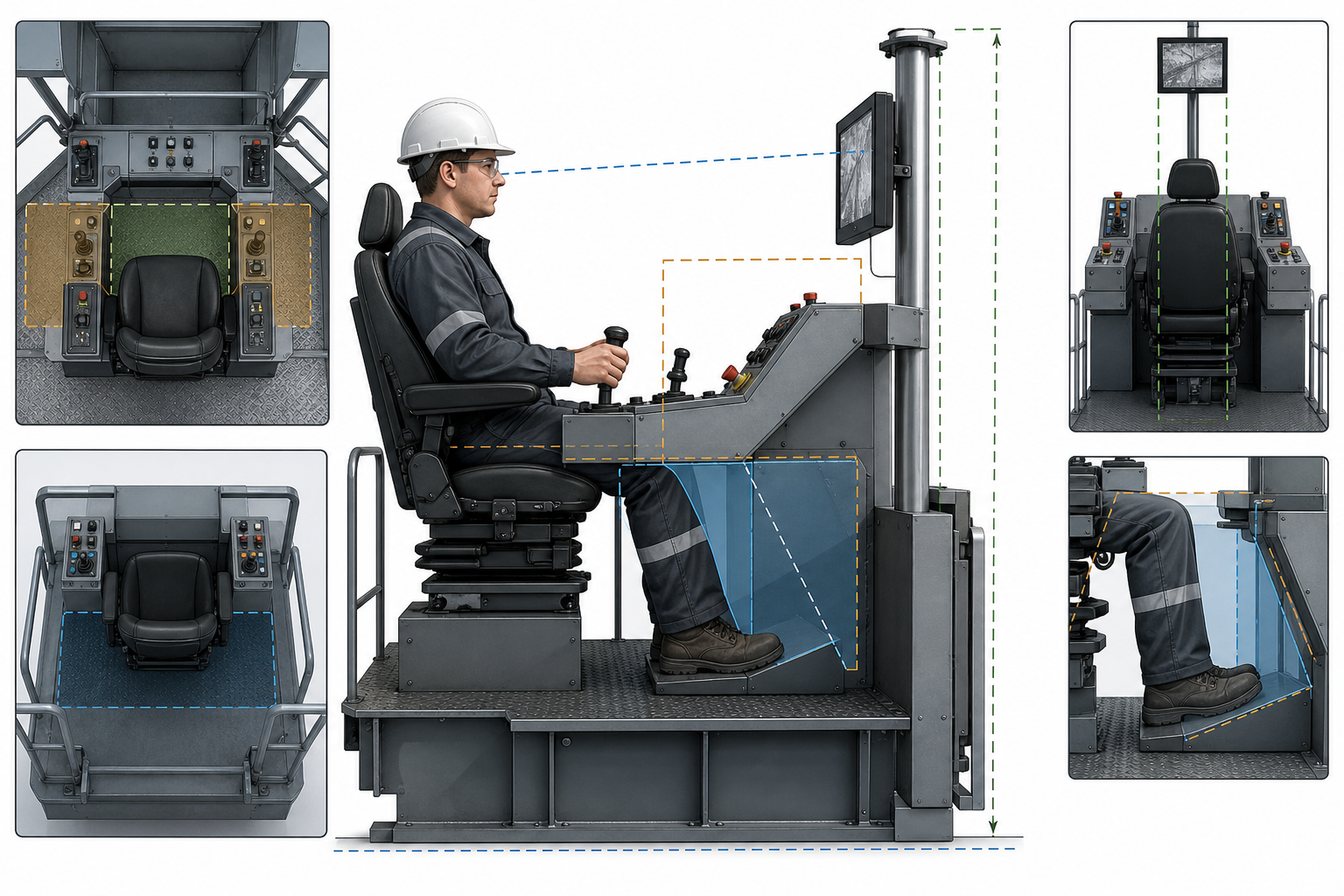
Why shredder pulpits fail catalog swaps
Metal shredder lines combine feed-equipment vibration, particulate ingress, and maintenance windows measured in minutes, not hours. Buyers who drop a catalog office chair beside ad-hoc side panels typically discover failures within the first maintenance cycle: rotation locks slip under vibration, lateral boxes sit too close for lid swing, knees strike the monitor mast, and declared IP ratings do not survive real gasket paths.
Trunsin treats shredder pulpits as engineered assemblies. First article inspection typically surfaces gaps in four areas before any batch ships — enclosure finish and sealing, ergonomics, mechanical reliability, and compliance/access. Each finding lands on a structured gap record with owner, corrective action, and re-inspection column. That is the opposite of swapping a standard chair and bolting on generic panels.
Environmental load: dust, vibration, and honest IP
Shredder pulpits see condensing ceilings, occasional washdown proximity, and abrasive dust. Trunsin targets IP31 closed / IP20 opened on lateral boxes — closed protects against vertically dripping water; opened acknowledges maintenance with lids raised. First article often flags sharp punched edges and non-standard gasket routing; passivation and corrected seal paths are tracked items with re-inspection, not cosmetic touch-ups.
Where pickling atmospheres attack paint alone, 304 stainless steel lateral panels are offered alongside RAL finishes — a configuration choice tied to enclosure longevity, not appearance alone.
Ergonomics under multi-shift crews
Steel shredder plants run crews with different anthropometrics. Trunsin validates reach and clearance with at least two operator weight/height brackets — dimensioned 3D review plus seated verification video, not theoretical CAD manikins alone.
Typical adjustments on shredder-line programs:
- Inter-box distance widened after studying customer reference drawings and lid swing clearance
- Lateral box depth set to match existing pulpit layout and cable routing — depth in the 350–400 mm range is common on integrated builds
- Foot-holder height adjusted after video review against reference seat heights in the 500–540 mm range
- Knee vs monitor — bracket and seat geometry adjusted so tall operators no longer strike the open-frame display (VESA 100 × 100 and 200 × 200 patterns; monitor mass and cable exit checked in 3D gate)
Hand rest placement is evaluated on chair vs lateral box depending on reach and box lid swing — a decision that only makes sense when boxes are engineered as part of the operator seat assembly, not added later.
Structure and electrical access during running shifts
Operators brace against foot rests during alarm responses and feed adjustments. First article inspection often flags foot rest flex; engineering responds with stiffening plates and documented static load validation before batch release — evidence on the gap record, not a datasheet adjective. Base structure is re-engineered when foot-holder height changes the load path.
Electrical access must balance security and service time:
- Double-bit key lids restrict casual opening while keeping tool-based maintenance predictable
- Gas springs on the internal side of lids keep hardware away from operator legs
- Grounding bolt labels on released 3D models align with IEC 60204-1 themes on the complete control console assembly
- CE marking scope covers the complete operator seat station when required by target market
Monitor mast requirements on shredder builds: horizontal-only orientation with positive lock, shortened deburred fasteners for full rotation without snagging, and a reinforced bracket when arm shake traces to loose fasteners.
Shredder-line specification checklist
| Item | Shredder-specific target | Evidence Trunsin provides |
|---|---|---|
| Lateral box layout | Depth and inter-box spacing matched to reference drawings | 3D release + dimensional review |
| Operator range | Two anthropometric brackets minimum | Verification video with seated operators |
| Foot rest structure | Explicit static load criterion in RFQ | Load test documentation + gap-record sign-off |
| IP declaration | IP31 closed and IP20 opened | Gasket routing + passivation re-inspection |
| Monitor duty | VESA pattern, mass, cable exit | Open-frame HMI spec checked in 3D gate |
| Access policy | Tool-only vs keyed lids | Double-bit key + internal gas springs |
| Compliance | CE + IEC 60204-1 on complete assembly | Documented at intake; not deferred post-build |
Frequently asked questions
How does a shredder pulpit operator seat differ from a crane cabin seat?
Both need integrated lateral boxes and vibration duty, but shredder lines add heavier particulate exposure, more aggressive maintenance cadence, and foot-rest bracing during alarm response. Shredder specs should emphasize IP implementation in open/closed states, foot rest load evidence, and corrosion material choices near pickling zones.
Can Trunsin match an existing shredder pulpit layout?
Yes. Reference drawings drive inter-box spacing, box depth, monitor mast geometry, and rotation lock placement. Customer-supplied drawings and a structured gap record — not a catalog SKU — define the configuration.
What should we send before requesting a quotation?
Photos of the existing station (front, side, lids open), monitor VESA spec and mass, operator height/weight brackets, IP and material requirements, and any corporate specification sheet or hand-marked reference drawing. Trunsin returns a gap analysis and 3D review path before metal is cut.
How is ergonomics validated when procurement teams are remote?
Dimensioned 3D reviews plus short verification videos: rotation lock engagement, monitor movement without snagging, foot-rest load, and box opening clearance with a seated operator. Videos are stored against gap-record row numbers for audit retrieval.
Start your operator seat project
- Share shredder pulpit photos or an existing specification sheet
- Review control console platforms as baselines
- Contact sales@trunsin.com for engineering review and quotation